Internal · Sentinel

How Sentinel gets sharper on autopilot

Runflow can automatically judge whether an AI-generated image is good — that's Sentinel. This is how that judgment gets sharper every cycle, and turns into a data asset competitors can't simply buy. Runflow is live · Arena is a prototype · Benchmark is live as a CLI · the Autopilot is next. Every part below is tagged.

Live — running today Prototype — built, iterating Building — next, not live
Runflow Arena Benchmark Autopilot a sharper Sentinel
every turn deepens the data moat — the compounding payoff
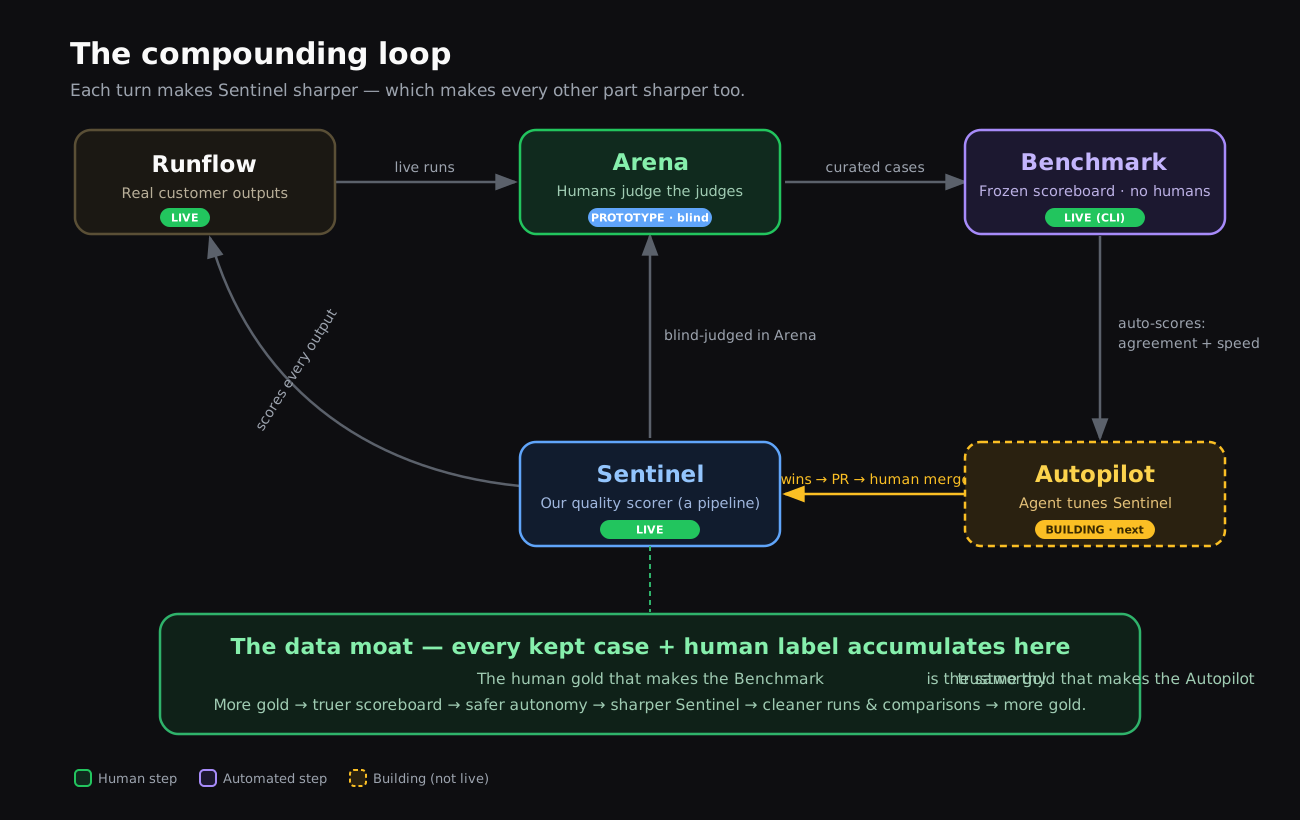
The compounding loop: Runflow → Arena → Benchmark → Autopilot → Sentinel, on a data-moat foundation
The compounding loop — every turn makes Sentinel sharper, which makes every other part sharper too.tap to enlarge
// 00Live

Sentinel is a pipeline, not a score

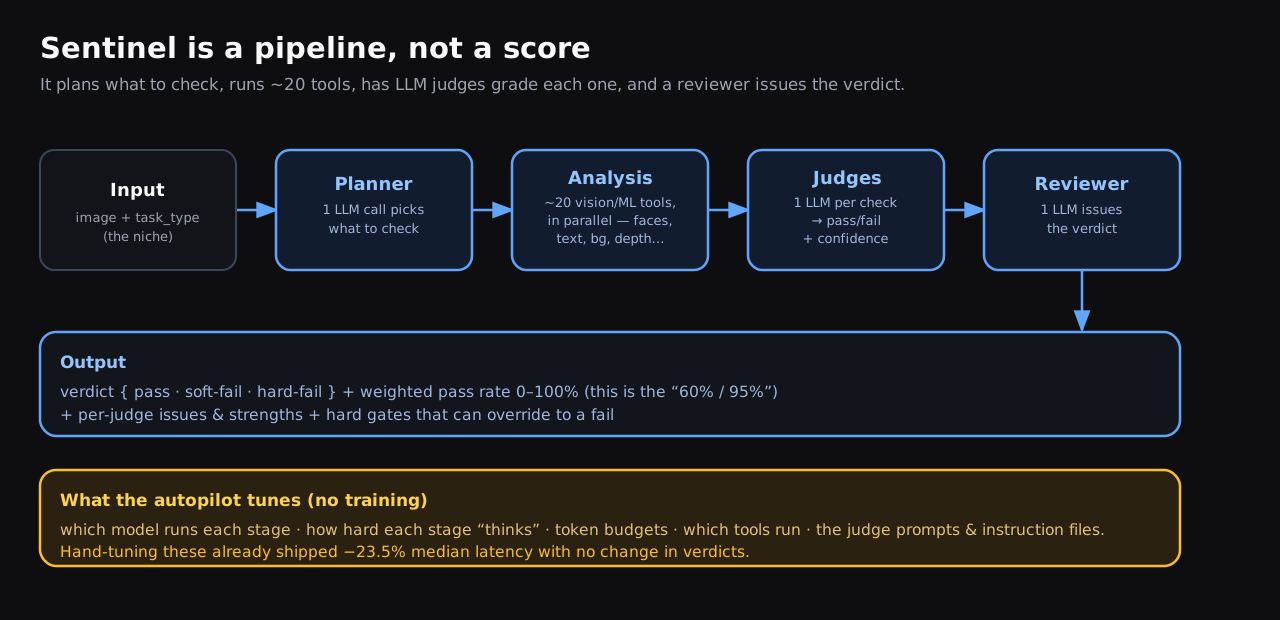
It's easy to call Sentinel "our quality scorer," but that undersells it. For every image it plans what to check, runs ~20 vision/ML checks, has LLM judges grade each dimension, and a final reviewer returns a verdict — pass / soft-fail / hard-fail — plus a 0–100% weighted pass rate (pass = 100%, soft-fail = 70%, hard-fail = 0%, with hard gates called out separately). That percentage is the "60% / 95%" you'll see below — it's a pass rate, not model confidence.

Hold onto this the whole way down: Sentinel improves by changing its prompts, tools and wiring — not by training a model. No fine-tuning. That's what makes the loop cheap, fast, and safe to put on autopilot.
Sentinel pipeline: Input → Planner → Analysis → Judges → Reviewer → verdict
Plan → analyze with ~20 tools → judge each check → review → verdict + weighted pass rate.tap to enlarge
// 01Live

Runflow — the fuel

Everything starts with real work. Every Runflow job — headshots, product shots, background removal, virtual try-on — produces a real output, in the exact mix of niches our customers actually run. For each output image, Sentinel writes an evaluation. On top of that we capture two human signals: a 👍/👎 on the run, and a separate 👍/👎 on whether Sentinel itself got it right.

What turns raw outputs into a learning signal is the disagreements:

Customer 👍 · Sentinel 60%
Sentinel was probably too strict.
Customer 👎 · Sentinel 95%
Sentinel probably missed something.

This is production data, not lab data — the real distribution, with real human reactions attached. Today we learn only from our own internal and consented traffic; customer opt-in is on the roadmap, behind a clear legal basis. That discipline is a feature — the moat only compounds if it's built on data we're actually allowed to use.

// 02Prototype

Arena — judge the judges

The trick is subtle. I can't cheaply ask a human "is this image good?" at scale and get consistent truth. But I can ask "which of these evaluators do you most agree with?" — and that tells me which judge sees quality the way we want.

So Arena takes one real output and has a panel score it in one shared format. A human then picks the evaluator whose verdict they most agree with, and a leaderboard ranks the judges by how often humans agree.

SentinelGemini 3.1 ProClaude Opus 4.8GPT-5.5Gemini 3.1 Flash Lite
Blind & server-enforced. Ballots are HMAC-sealed server-side and judge names reveal only after you vote — nobody gets a halo for being "Sentinel" or "GPT." It runs on eligible internal/consented traffic: every 30 min it imports fresh runs, copies the images to our own storage, and an Opus arbiter pre-ranks cases so humans spend time where it matters. The point: ground truth that isn't Sentinel grading itself.
// 03LiveCLI

Benchmark — the frozen scoreboard

Two things share the word "benchmark," so let's split them:

Arena = humans

deciding which judge to trust.

Benchmark = no humans

a frozen set of cases we re-grade Sentinel against.

The Benchmark is live today as a command-line tool: ~64 hand-picked cases across 8 niches, frozen so they never change between runs. Run a candidate Sentinel campaign/config against it and it tells you, per niche, whether that candidate improved, held, or broke something — and it flags pass→fail regressions. It even labels each call:

correcttoo stricttoo lenientmissed the key issue

The rule that keeps it honest: we never train on this set. It's a measuring stick, not a textbook. Still building: exact Sentinel build/version stamping · an always-on dashboard · a frontier panel inside the benchmark · a release gate that blocks regressions.

// 04Building — next

The autopilot — an autonomous researcher

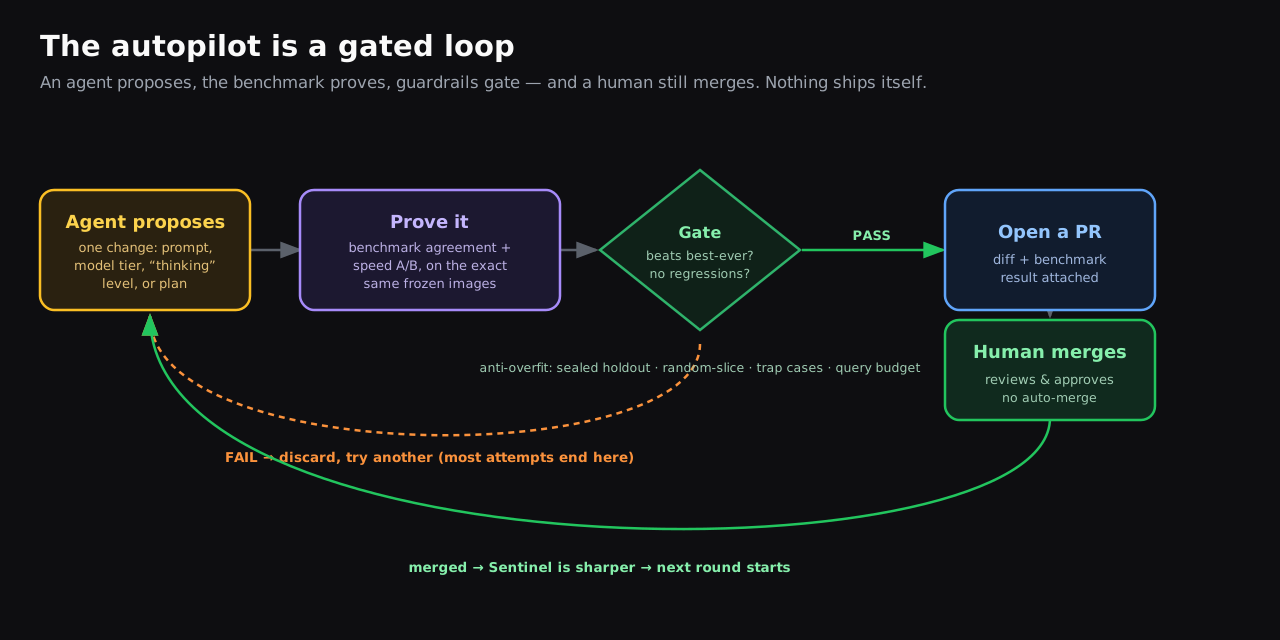
This is the part we never talked about, and it's the reason the title says "autopilot." Once the Benchmark is a trustworthy scoreboard, the next step is to point a Claude Code agent at it and let it propose changes to Sentinel — using the knobs Sentinel already exposes (judge prompts, which model runs each stage, how hard each stage "thinks," the analysis plan) toward one objective: higher agreement with our human-gold benchmark, and lower latency.

Propose Prove · benchmark + speed A/B Gate · anti-overfit Open a PR· a human merges

No auto-merge. No weight training. It never ships itself to production.

Gated autopilot loop: propose → prove → gate → PR → human merge
The autopilot is a gated loop — most attempts are discarded; that's the point.tap to enlarge
The speed half is already real and measured: hand-tuning these same knobs cut Sentinel's median latency 23.5% with no loss in verdicts. The autopilot is "try that repeatedly, under gates." But an autopilot is only as good — and only as safe — as the scoreboard it optimizes against. So where does a trustworthy scoreboard come from, and why couldn't a competitor just buy one?
// 05Live+ compounding

The data moat — the payoff

That trustworthy scoreboard runs on human-adjudicated gold — and that's the moat. The scarce, hard-to-copy asset is human-adjudicated gold on our own internal/consented production distribution, by niche — and it deepens with every case we can legally keep.

Here's the non-obvious part: today's best AI vision models are genuinely weak judges of image quality — GPT-4o correlates only ≈0.22 (Pearson) with human quality votes on GenAI-Arena. So you can't buy your way to a reliable judge. Our own first 100-case human-agreement run already hit 70.4% — a real precedent, and the baseline to beat.

Defensibility = how many niches we cover × how good our labels are × the governance to use the data responsibly. That consent discipline isn't a constraint around the moat — it's part of it. And it's the same gold that lets the autopilot run safely: more gold → a truer scoreboard → safer autonomy → a sharper Sentinel.

// 06

The loop, and what keeps it honest

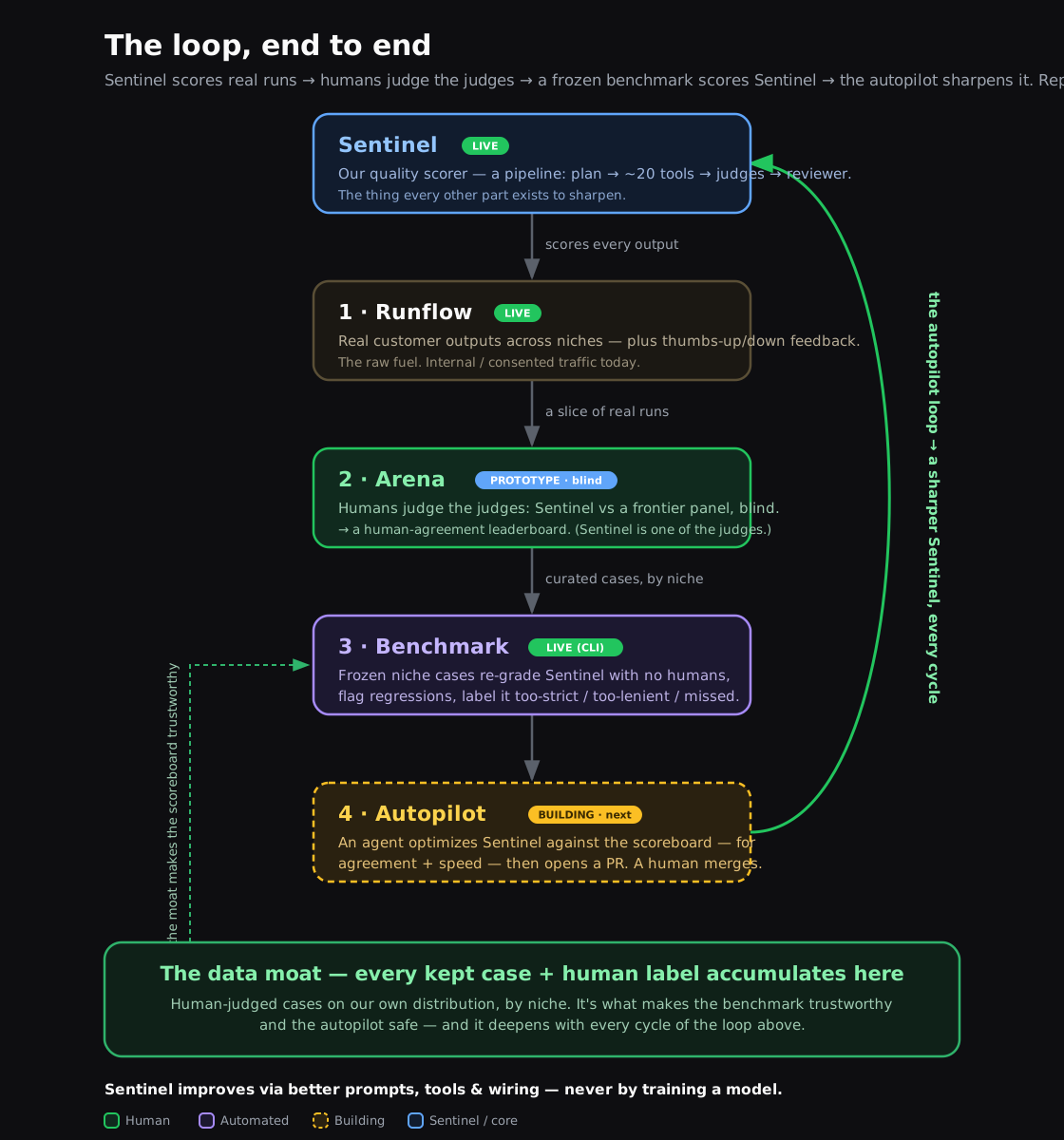
Put it together and it's a flywheel: a sharper Sentinel makes Runflow's scoring and Arena's comparisons cleaner → better cases and cleaner curation → a bigger benchmark → the autopilot sharpens Sentinel again.

End-to-end loop with Sentinel as the anchor node and the autopilot loop-back
End to end — Sentinel at the center, the autopilot loop closing back to a sharper Sentinel.tap to enlarge
01

Humans are the speed limit

The AI scoring is cheap (~$25–50/day). The scarce input is expert labels — ~75–350/week from one VA plus me on contested calls. If curation stalls, the loop stalls.

02

Don't over-tune to our own test

Even without training, tweaking against a fixed set is still optimization. Designed guardrails: a best-ever anchor + CUSUM drift alarms, a sealed holdout, a gate-query budget, random-slice metrics, org×prompt-cluster splits, trap/canary cases.

03

Freeze the benchmark

If cases move between comparisons, the scores mean nothing. Versions stay immutable; on rotation we re-score under both so the trend stays honest.

That's the real meaning of "autopilot": not blind self-improvement — a tight loop that proposes, proves, and keeps only the wins.
// the numbers
−23.5%
Median latency
measured · verdicts preserved
70.4%
Human-agreement
100-case baseline to beat
≈0.22
GPT-4o · human-quality corr.
Pearson, GenAI-Arena · why you can't buy a judge
$25–50
LLM cost / day
humans are the real limit